If you run a business, you have likely stood at this major crossroads: Do you pour your budget into SEO vs. Google Ads, or do you try to find a way to make both work? It is the classic digital marketing debate of our time. One promises a slow, steady climb to the top of search results, while the other offers a fast-track ticket to the spotlight.
If your goal is long-term growth, the answer is not as simple as picking one over the other. To grow a sustainable, profitable business in 2026 and beyond, you need to understand the fundamental mechanics of SEO vs. Google Ads. In this comprehensive guide, we will break down the differences, explore how they impact your bottom line, and show you why the most successful businesses don’t actually choose between them—they use them together to dominate their market.
Defining the Players: SEO vs. Google Ads
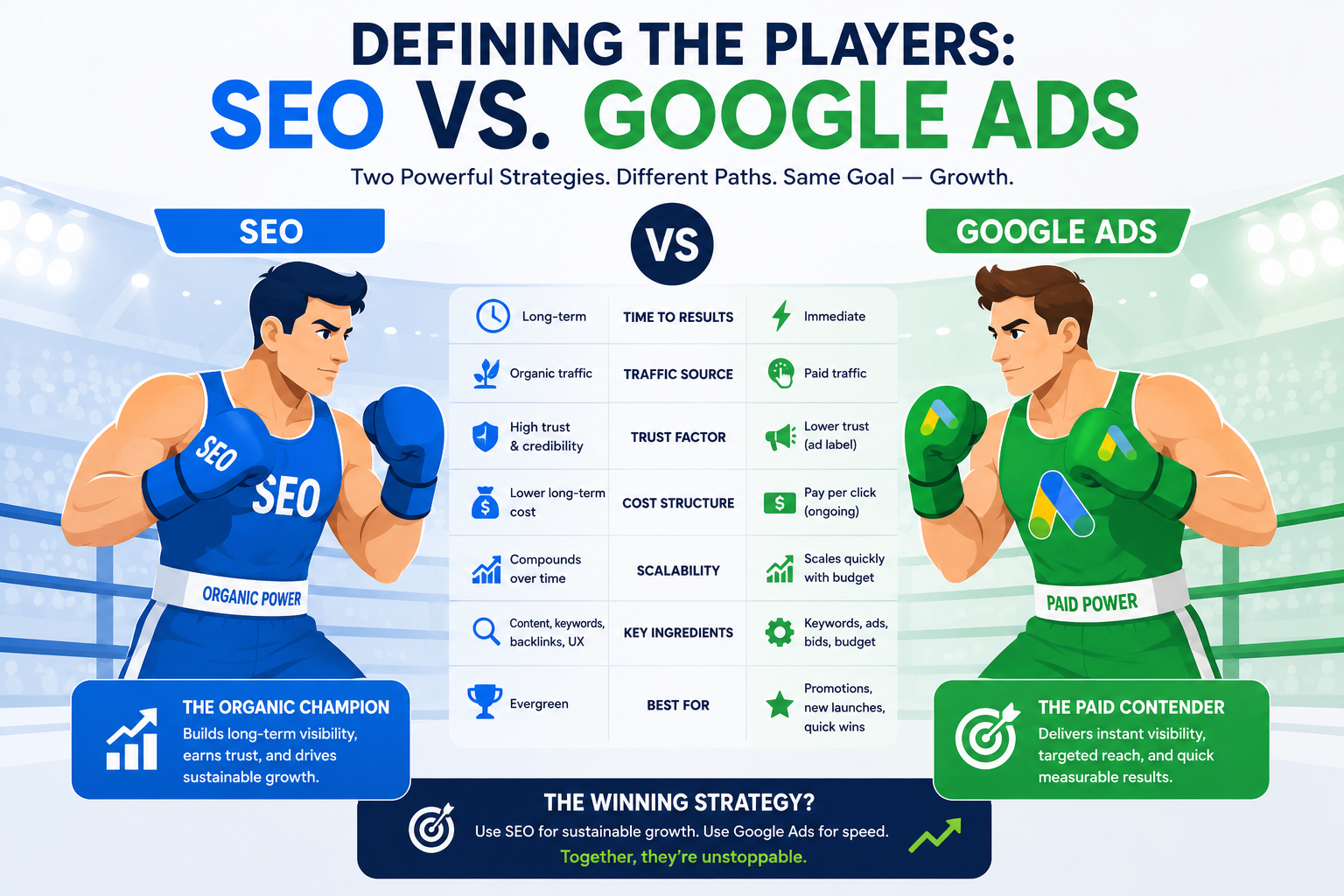
To make the right choice, we must first define the two sides of the coin. When comparing SEO vs. Google Ads, we are essentially looking at two different philosophies of business growth: "earned" versus "bought."
What is SEO?
Search Engine Optimization (SEO) is the process of improving your website so it appears higher in "organic" (unpaid) search results.
Think of SEO like building a beautiful, permanent brick-and-mortar store. You spend time and effort constructing a great building, stocking your shelves, and earning a reputation so that customers naturally want to walk through your doors. Once you earn that spot, you don't have to pay a "toll" every time a customer walks in. It is a long-term asset that belongs to you. In 2026, SEO has evolved to include sophisticated elements like voice search optimization, AI-driven content alignment, and local map pack dominance.
What are Google Ads?
Google Ads (often called Pay-Per-Click or PPC) is a paid advertising platform. You bid on specific keywords, and your business appears as a "Sponsored" result at the very top of the search page.
If we go back to our store analogy, Google Ads is like hiring a person to stand on the corner with a bright neon sign, waving people into your shop immediately. It works instantly and effectively, but the moment you stop paying that person to hold the sign, they go home, and the flow of customers stops.
The Core Differences at a Glance
|
Factor |
SEO (Organic) |
Google Ads (Paid) |
|
Traffic Type |
Earned (Organic) |
Bought (Paid) |
|
Time to Results |
Moderate to Slow (3–6 months) |
Immediate (Minutes) |
|
Sustainability |
High (Long-term asset) |
Low (Dependent on budget) |
|
Trust Factor |
High (Seen as objective) |
Moderate (Seen as promotional) |
|
Cost |
Fixed or effort-based |
Variable (Cost-per-click) |
|
Visibility |
Requires consistent optimization |
Starts immediately |
Why SEO is the Engine for Long-Term Growth
If you are thinking five or ten years down the road, SEO is your most valuable asset. When business owners debate SEO vs. Google Ads, they often find that SEO is the "gold standard" for sustainable success.
A. The "Snowball Effect" of Content
SEO has a powerful "snowball effect." In the beginning, you might write ten blog posts and see very little traffic. But as you add more high-quality content, build authority, and gain trust with Google, that small trickle of traffic turns into a steady, rushing stream. Every page you optimize today is a digital asset that can continue to bring in visitors for years without costing you a penny more in advertising fees.
B. Building Brand Trust
Users are savvy. They know the difference between a "Sponsored" ad and an organic result. Studies consistently show that searchers trust organic results more because they feel like a genuine recommendation from Google, not a pitch from an advertiser. Ranking #1 organically signals to the world that your brand is an authority in your industry.
C. The Cost-Efficiency Factor
One of the biggest arguments in the SEO vs. Google Ads debate is cost. While SEO requires an upfront investment in content, technical work, and strategy, it is essentially "free" traffic once you rank. You aren't paying a fee every time someone clicks your link. This makes your long-term Customer Acquisition Cost (CAC) significantly lower than a strategy that relies solely on paid ads.
D. Resilience Against Market Shifts
When you rely solely on paid ads, you are vulnerable to "ad fatigue" and rising bid prices. As more competitors enter your space, the cost to stay at the top increases. With SEO, your authority is built on the foundation of your site structure, your backlinks, and your content—elements that aren't subject to daily bidding wars.
The Power of "Now": When Google Ads Wins
If SEO is the long-term investment, Google Ads is your "tactical strike." It solves specific business problems that SEO cannot touch. Sometimes, the SEO vs. Google Ads question isn't about which is better, but which is better right now.
A. Instant Results
Need to launch a new product tomorrow? SEO won't help you there, as it takes time for search engines to index and rank new pages. Google Ads can get you to the top of the search page in less than an hour. If you have a time-sensitive offer, a seasonal promotion, or you are a new business, Ads are your best friend.
B. Precision Targeting and Testing
Google Ads gives you incredible control. You can choose to show your ads only to people in a specific city, during business hours, or even to people who have visited your site before. This level of control is great for testing what your customers actually want. You can use these insights to inform your overall SEO vs. Google Ads strategy.
C. Market Validation
Not sure if a product will sell? Use Google Ads to test your messaging. If people click your ad, you have proof that your offer is good—making it a perfect candidate to eventually invest in for SEO.
The "Stop-Button" Problem in SEO vs. Google Ads
A major reason businesses struggle with Google Ads is the "faucet effect."
Because you pay for every single click, your traffic is directly tied to your budget. As soon as you hit your daily limit or pause your campaign, your visibility vanishes instantly.
This is why relying only on ads is risky. If your budget is cut, your entire lead pipeline can dry up overnight. SEO acts as your safety net. When you compare SEO vs. Google Ads, remember that SEO provides a foundation of visitors that exists regardless of your monthly ad spend. It is the difference between renting your customer base and owning it.
The Smart Strategy: The "Bridge Method"
The best way to achieve long-term growth is not to pick a side, but to bridge the two.
Use Ads to Fuel SEO
Use Google Ads as a testing ground for your SEO vs. Google Ads strategy. Run ads for different keywords to see which ones actually lead to sales. Once you find a "winner," build high-quality, long-form content around it for your SEO. This prevents you from wasting months of work on keywords that don't bring in revenue.
Occupy More Space
When you have an ad at the top of the page and an organic result right below it, you own the "real estate" of the search results. This builds massive credibility. It makes your business look like the "biggest and best" in your industry.
Analyzing Technical Factors in SEO vs. Google Ads
To win at SEO vs. Google Ads, you must understand the technical environment. SEO is not just about writing content; it’s about site speed, mobile-friendliness, and secure connections. When you invest in SEO, you are improving the overall quality of your website, which benefits every other marketing channel you use.
Google Ads, meanwhile, requires an understanding of bidding strategies, quality scores, and landing page optimization. A high-quality landing page can lower your cost per click, making your ads more profitable. This is where your SEO efforts pay off twice: a site optimized for SEO is almost always a site that is optimized for better ad performance.
Data-Driven Synergy: Using Both Channels
The true power of combining these two is in the data. By using Google Ads, you get near-instant feedback on which headlines, offers, and keywords drive actual sales. You can then feed this data into your SEO strategy.
For instance, if you notice that a specific ad headline has a high click-through rate, that is a massive clue for your SEO meta-titles and content structure. Conversely, your organic search data can help you find "long-tail" keywords that are too expensive to bid on via ads but have high search intent. By focusing your organic efforts on these hidden gems, you can save thousands of dollars in ad spend annually.
Common Pitfalls to Avoid
Even with a strong strategy, businesses often trip over these three mistakes:
-
Ignoring Conversion Tracking: You cannot optimize what you do not measure. Whether you are running ads or doing SEO, you need clear conversion tracking on your website.
-
Expectation Mismatch: Expecting SEO to generate massive leads in 30 days is a recipe for frustration. Similarly, expecting Google Ads to be profitable without proper landing page testing is a waste of budget.
-
Treating Them as Silos: If your SEO team and your Ads team are not talking, you are losing money. They should share keyword lists, landing page data, and customer insights to create a unified brand presence.
The Future of Search: SEO vs. Google Ads in 2026
In 2026, the search environment is more competitive than ever. Artificial intelligence is playing a larger role in how users interact with search engines. While search engines are evolving, the fundamentals remain: providing the best answer (SEO) and capturing high-intent traffic (Ads) are still the two most effective ways to grow online.
Businesses that dominate in 2026 are those that have built an "authority first" approach. They aren't just trying to hack the algorithm; they are building deep, valuable content that earns trust. Then, they layer Google Ads on top to ensure they are visible when potential customers are ready to pull the trigger.
Conclusion
In the battle of SEO vs. Google Ads, there is no single winner—the winner is the business owner who understands how to use both. SEO is the slow, steady build of a lasting business, while Google Ads is the high-octane fuel that drives immediate results.
If you want to survive today, you might need ads. But if you want to thrive for years to come, you must build your SEO foundation. The businesses that win are the ones that use ads to stay visible while they patiently build an SEO strategy that generates traffic for years to come.
Need Help Choosing the Right Channel?
Choosing between these two can be confusing, and you don’t want to waste your hard-earned money on the wrong strategy. At BizPartner 360 LLC, we specialize in making these choices simple and effective for you.
We can help you analyze your current traffic, audit your website, and design a balanced plan that delivers results today and secures your growth for tomorrow.
Contact us today, and let’s talk about a plan that fits your business perfectly.

Arlo Bennett is a tech blogger and digital culture journalist who translates complex innovations into clear, compelling narratives.
Get started with ...